Trigonometry
Degrees vs Radians: A Simple Comparison for GCSE Maths
Put two students in front of the same angle and ask them to write down its size. One writes 60°, the other writes π/3. Neither is wrong. Degrees and radians are two ways of measuring the same turn, just as metres and feet both measure the same corridor. GCSE maths is taught almost entirely in degrees, which is why radians can feel like an uninvited guest. Once you see where they come from, they stop being a mystery.
Degrees: the unit you already trust
A degree is one part of a circle split into 360 equal pieces. That makes a full turn 360°, a straight line 180° and a right angle 90°. The number 360 is a human choice rather than a fact of nature, but it is a practical one: it divides neatly by 2, 3, 4, 5, 6, 8, 9, 10 and 12, so fractions of a circle land on whole numbers.
Degrees are also easy to picture. You can look at an angle on a page and guess it is somewhere near 40°. Nobody estimates radians by eye. If you have spent years with a protractor and a set square, degrees are the language your intuition already speaks.
Radians: measuring with the radius
A radian is defined by the circle itself rather than by a chosen number. Take any circle, take its radius, and lay that length along the circumference as an arc. The angle at the centre created by that arc is one radian.
Now count how many radius lengths fit around a full circle. The circumference is 2πr and each radius is r, so exactly 2π of them fit. That gives the relationship worth memorising: a full turn is 2π radians, which is 360°. Halve it and π radians is 180°. Quarter it and π/2 radians is 90°.
In decimals, one radian is about 57.3°, so a radian is a little less than 60° and two radians is a bit more than a right angle. That fact alone will save you from most daft answers.
Converting between the two
Since π radians equals 180°, every conversion is a fraction. Multiply by π/180 to go from degrees to radians, and by 180/π to come back the other way.
For example, 150° becomes 150 × π/180 = 150π/180 = 5π/6 radians. Working in reverse, 3π/4 radians becomes 3π/4 × 180/π = 135°. Notice how the π cancels when you return to degrees, leaving a plain number behind.
Angles that turn up most often in questions have tidy exact values. Worth keeping in memory:
- 0° = 0
- 30° = π/6
- 45° = π/4
- 60° = π/3
- 90° = π/2
- 120° = 2π/3
- 135° = 3π/4
- 150° = 5π/6
- 180° = π
- 270° = 3π/2
- 360° = 2π
Two habits make the conversions reliable. First, cancel the fraction before reaching for a calculator: 90π/180 should become π/2 by hand. Second, leave the π in the answer unless the question asks for a decimal. Writing 1.57 instead of π/2 throws away accuracy and usually costs a mark.
Why radians exist at all
If degrees are familiar, why bother with radians? Because several formulas become dramatically simpler.
In degrees, the arc length of a sector is (θ/360) × 2πr and its area is (θ/360) × πr². Both carry a conversion factor wrapped up inside the 360. Work in radians and the clutter disappears: arc length is rθ and sector area is ½r²θ, where θ is in radians.
There is a second reason that matters beyond GCSE. In calculus, the derivative of sin x is cos x only when x is measured in radians. Switch to degrees and an extra constant appears. That is why A-level switches to radians as soon as trigonometry gets serious.
Which unit does your exam want?
For GCSE maths, assume degrees unless the question says otherwise. Triangle work, the sine rule, the cosine rule and SOHCAHTOA are all taught in degrees at this level. Radians appear in some Further Maths GCSE and IGCSE specifications, and become the default at A-level.
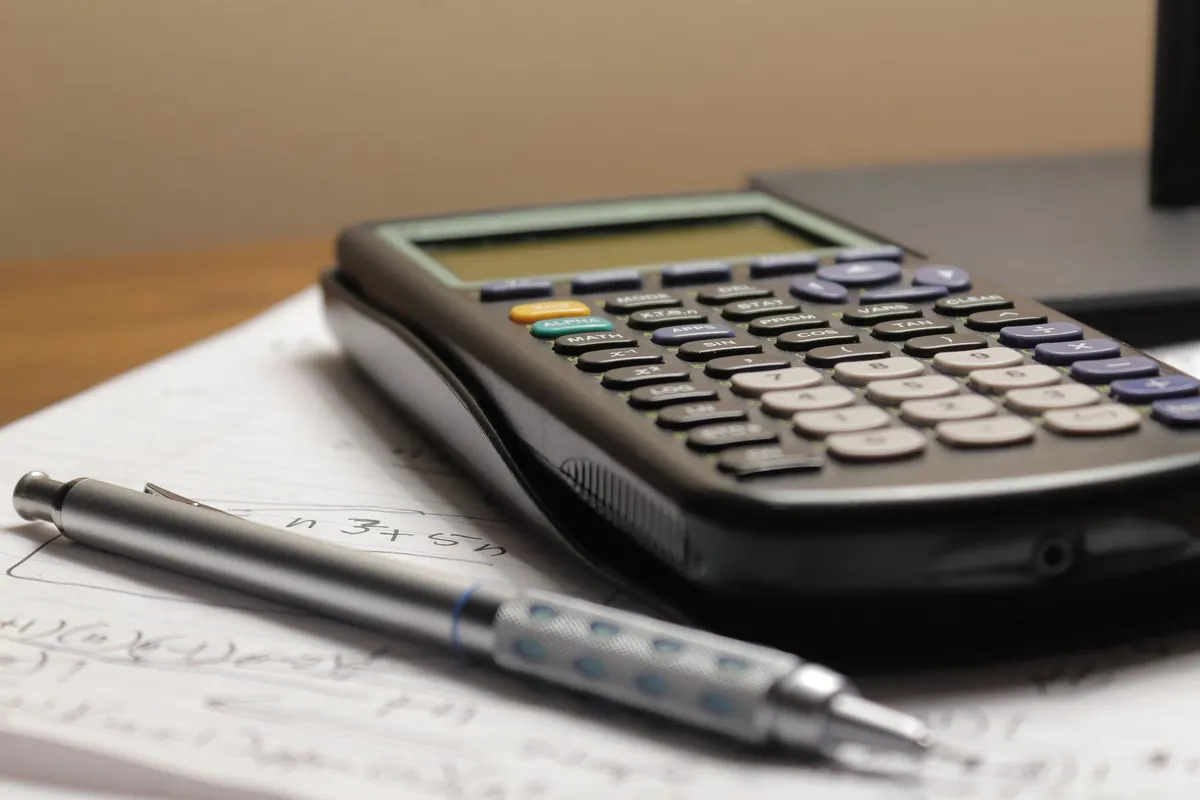
Your calculator needs checking too. The screen shows a small DEG or RAD indicator, and it is easy to change by accident. Before you start any trigonometry question, look at it. A quick test is to work out sin 30: in degree mode you get 0.5, and if you get anything else, every angle answer that follows will be wrong.
Three mistakes that cost marks
- Using the arc formulas with degrees. Arc length = rθ and sector area = ½r²θ only work when θ is in radians. Feed a degree value in and the answer is meaningless.
- Leaving the fraction uncancelled. An answer of 60π/180 will not earn full marks when π/3 is expected.
- Forgetting the calculator mode. The simplest error to make, and the easiest to avoid.
A routine that keeps your answers right
Read the question's units first: if it mentions π or says "in radians", you are working in radians. Check the calculator display next. Then convert using the fraction and cancel before doing any other arithmetic. Finally, sense-check the size. If an angle is described as 4 radians, that is roughly 229°, an angle swinging well past a straight line, not a small one.
Treat degrees and radians as two dials on the same instrument. Learn the handful of conversions you meet most often, keep an eye on the mode, and the unit that once looked strange becomes just another tool for the same job.
Photo: Aaron Lefler / Pexels
Related Articles